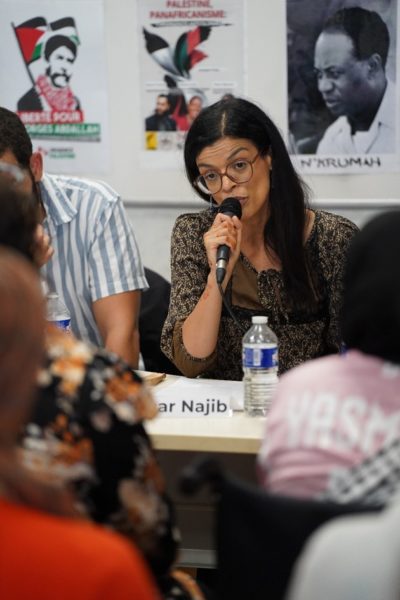
Intervention de Kawtar Najib, géographe à l’Université de Liverpool (en Angleterre), spécialiste de l’islamophobie et de la justice sociale et spatiale, lors du meeting unitaire de l’Espace Malcolm X « Palestine, Panafricanisme : convergences anticoloniales » le dimanche 20 juillet 2025 à Paris. Vidéo disponible ici.
« Ils peuvent tout nous prendre […], mais tant qu’ils n’ont pas pris notre dignité, alors on n’a rien perdu »
Je suis Kawtar Najib, géographe française. J’ai dû quitter la France pour obtenir un poste de maître de conférences, car le monde académique français reste largement fermé aux chercheurs racisés[1] travaillant sur les questions anticoloniales telles que l’islamophobie, la Palestine et la nécessité de résister en faisant converger nos luttes. Dans ce texte, je mets en lumière le lien entre islamophobie et racisme antipalestinien, et j’explique comment le génocide à Gaza affecte les Musulmans du monde entier, dont l’engagement est crucial pour y mettre fin.
Dans la littérature scientifique, l’islamophobie est définie comme une forme de racisme antimusulman visant les expressions de la Musulmanité, qu’elles soient réelles ou supposée[2]. Dans mon premier ouvrage intitulé « L’islamophobie spatialisée » (‘Spatialized Islamophobia’)[3], j’ai expliqué que ce phénomène constitue un processus multiscalaire, présent à toutes les échelles — du globe jusqu’au corps. L’islamophobie est également multidimensionnelle, puisqu’elle traverse l’ensemble des secteurs et des espaces de la société : la politique, les médias, le système judiciaire, la police, l’emploi, l’éducation, Internet, l’espace public et même parfois le foyer domestique. C’est pourquoi j’ai proposé la notion d’« islamophobie partout » (‘Everywhere Islamophobia’)[4] en écho au premier principe de la Critical Race Theory[5], qui rappelle que le racisme est omniprésent.
La géographe Ruth Wilson Gilmore a, dès 1993[6], mis en évidence l’omniprésence du racisme et du machisme. De son côté, Derek Gregory a montré dans son article ‘The Everywhere War’[7] que la guerre contre le terrorisme s’étend désormais à l’échelle planétaire, ce qui fait directement écho à l’omniprésence de l’islamophobie. Cette dernière se manifeste partout, mais de manière différenciée selon les contextes. On l’observe aussi bien dans les pays occidentaux qu’en Asie ou encore dans des pays l’observe aussi bien dans les pays occidentaux qu’en Asie ou encore dans des pays majoritairement musulmans. Ses formes de violence varient, allant du mépris et des micro-agressions jusqu’aux crimes contre l’humanité.
L’islamophobie est un phénomène mondial qui façonne la vie quotidienne des Musulmans en fonction de contextes nationaux. La manière dont le « problème musulman » est construit dans chaque pays s’inscrit généralement dans un récit historique national spécifique, qui sert à justifier, voire à légaliser, les actions antimusulmanes. Ces manifestations prennent des formes variées : des lois discriminatoires (comme en France), des exclusions sociales et institutionnelles (comme aux États-Unis), ou encore des politiques fascistes légitimant les agressions physiques contre les Musulmans (comme en Inde). Dans les expressions les plus extrêmes de l’islamophobie, elles peuvent conduire au génocide et aux crimes contre l’humanité, comme on a pu observer au Myanmar, en Chine, en Bosnie ou, plus actuellement, à Gaza.
Le Professeur Khaled Beydoun[8] décrit notre époque comme une « ère d’islamophobie génocidaire » qui est très dangereuse pour les Musulmans du monde entier. Les discours médiatiques et politiques traditionnels qui déshumanisent les palestiniens -hommes, femmes et enfants- résonnent avec ceux qui déshumanisent les Musulmans en général. Dans ce contexte, critiquer les actions du gouvernement israélien, entraîne presque systématiquement une accusation d’antisémitisme ou de sympathie terroriste. En revanche, l’expression de propos islamophobes se fait rarement sanctionner. Cette asymétrie révèle une forte corrélation entre l’islamophobie et le racisme antipalestinien.
Le financement de ces deux types de deshumanisation est étroitement corrélé, comme le montrent plusieurs rapports et notamment un article de Hatem Bazian en 2015 qui explique qu’environ 70% du financement de l’industrie de l’islamophobie provient de sources pro-sionistes[9]. Au Royaume-Uni, les travaux du sociologue David Miller révèlent que les discours islamophobes relayés par des figures comme Tommy Robinson s’appuient également sur des financements issus de réseaux sionistes. Dans son ouvrage co-écrit sur l’islamophobie, Miller démontre que le mouvement sioniste transnational reproduit et alimente des logiques d’exclusion à l’encontre des Musulmans[10]. En France, certains médias mainstream contrôlés des milliardaires islamophobes (qui ont pillé et continuent de piller les richesses africaines) contribuent à instaurer une véritable culture raciste et antimusulmane[11] aux conséquences dangereuses et parfois meurtrières.
Ces logiques reposent sur des constructions raciales et coloniales qui présentent les Palestiniens et les Musulmans comme des menaces intrinsèquement violentes. Elles ont été développées à travers le prisme de théories racistes comme le « choc des civilisations » et le « grand remplacement » qui oppose une supposée civilisation judéo-chrétienne blanche et éclairée à une civilisation musulmane racialisée, décrite comme barbare et sauvage. Si l’idée même d’une civilisation « judéo-chrétienne » est un non-sens historique, son instrumentalisation a servi à justifier l’invasion de Gaza et à perpétuer le dernier projet colonial de peuplement soutenu par les puissances occidentales.
La Palestine, et principalement Gaza, nous révèle avec une clarté effroyable la violence de ces logiques raciales et coloniales, ainsi que l’incapacité de nos gouvernements actuels à protéger les Palestiniens et les Musulmans, qu’ils vivent au Moyen-Orient, en Afrique ou en Europe. Ce petit bout de terre qu’est Gaza a défié – au prix de grands sacrifices – l’ordre mondial raciste dans lequel nous vivons. Gaza est ainsi devenue un symbole de résistance face aux puissances impérialistes. Une résistance reconnue et célébrée à l’échelle mondiale, et qui résonne tout particulièrement pour les Musulmans davantage ciblés par les violences individuelles et politiques depuis le 7 octobre[12].
Aujourd’hui en Occident – et ailleurs –, ce ne sont plus seulement les signes distinctifs de la Musulmanité (comme le hijab, le niqab ou la barbe) qui exposent à la répression ou à des violences criminelles. Désormais, ce sont aussi les signes distinctifs de la « Palestinité » (comme un keffieh, un slogan ou un drapeau) qui peuvent eux aussi mener à des sanctions et des agressions. L’identité palestinienne s’est ainsi « musulmanisée » et, inversement, les marqueurs de la Musulmanité se sont « palestinisés ». C’est ce que le professeur Salman Sayyid appelle la « palestinisation de la Musulmanité »[13], en écho à ce que le professeur David Theo Goldberg appelle la « palestinisation raciale »[14].
Leur argument est que cette confusion contribue à la déshumanisation des Palestiniens, des Musulmans, et de tous ceux perçues comme tels, par exemple les Arabes. Cela montre que racisme antipalestinien, racisme antimusulman et racisme anti-arabe partagent des frontières floues visibles aussi dans les définitions académiques : le premier est parfois décrit comme une forme de racisme anti-arabe[15], parfois comme une islamophobie nourrie d’Orientalisme[16]. Tous ces racismes – y compris le racisme antinoir – doivent être combattus, et les Musulmans peuvent y contribuer de manière significative à travers leur religion et leur spiritualité qui exigent d’être du côté de la justice[17].
Nous savons que l’islam interdit le racisme et l’oppression et appelle clairement à résister à l’injustice, comme l’enseigne le Prophète de l’islam (sws) dans ce Hadith : « Quiconque parmi vous voit une mauvaise action, qu’il la change avec sa main (en passant à l’action) ; s’il ne peut pas, qu’il la change avec sa langue (en s’exprimant) ; et s’il ne peut pas, alors par son cœur – et c’est là le degré le plus faible de la foi »[18]. C’est donc un devoir en Islam de s’élever contre l’injustice, même si cela implique d’aller à l’encontre de sa propre famille. L’universitaire Farid Esack a montré le rôle essentiel des Musulmans dans la libération de l’Afrique du Sud mobilisant les textes islamiques[19] pour appeler à la résistance.
Aujourd’hui, les Gazaouis résistent également grâce à leur foi. Ils continuent de louer Dieu au cœur même de leurs souffrances les plus douloureuses, convaincus d’être ‘les opprimés’ dont parle l’islam et que Dieu est de leur côté. Mais ce génocide que subit Gaza met en réalité à l’épreuve toute la Oumma. La communauté des Musulmans unis par leur religion. La résistance des Gazaouis, parmi les plus impressionnantes au monde, est un rappel pour tous. Pour y répondre, la Oumma doit avant tout se libérer de ses compromissions avec l’impérialisme, le capitalisme, le racisme, le sexisme et toute forme d’asservissement, car la Oumma a le devoir de rester du côté des opprimés.
Cette approche théologique est étudiée scientifiquement sous le nom de la « théologie de la libération » (ou ‘Liberation Theology’) née dans un contexte chrétien, notamment en Amérique latine, dans les années 1960 avec le philosophe Gustavo Guttierez[20], puis développés ailleurs, notamment en Palestine, avec les travaux du révérend Mitri Raheb[21] qui a fondé l’université Dar-al-Kalima à Bethlehem. Le génocide à Gaza ne concerne pas uniquement les musulmans, il touche aussi des non-musulmans. Les chrétiens palestiniens, par exemple, subissent eux aussi des massacres et abandon de la part des gouvernements et des peuples chrétiens occidentaux. Les chrétiens palestiniens deviennent ainsi victimes directes d’une islamophobie mondialisée.
Il est donc de notre devoir à tous d’instaurer une justice indivisible, une justice pour tous comme le rappelle Angela Davis[22]. Seules, les divisions fondées sur des critères moraux sont légitimes. Le génocide de Gaza nous a permis de mesurer ces critères moraux, il révèle qui se tient du côté de la justice pour tous et qui s’en détourne. Nous avons tous été témoins des mensonges, violences et fascisation de l’ordre mondial (néo)libéral qui déshumanise des catégories entières, Palestiniens, Musulmans, Arabes, Noirs, peuples du Sud Global. Tous participent à une même lutte contre l’oppression, même si chacun affronte ses propres formes locales d’injustice.
Plusieurs personnes ont développé, avec courage, une solidarité forte envers la Palestine, qui est devenue un symbole universel de résistance qui nous sauvera tous. Se tenir aux côtés de la Palestine, c’est se tenir aux côtés de tous les peuples opprimés, notre cœur restera apaisé et notre intégrité intacte. Bien que nos luttes semblent très dures et parfois écrasantes, je tiens à préciser qu’ils peuvent tout nous prendre (nos emplois, nos larmes, notre sueur, notre argent, notre énergie, etc.), mais tant qu’ils n’ont pas pris notre dignité, nous n’avons rien perdu.
FREE PALESTINE et FREE GAZA
Dr. Kawtar Najib
Fighting Islamophobia for Palestine
Speech by Kawtar Najib – a geographer at the University of Liverpool (England) specializing in Islamophobia and social and spatial justice – at the joint gathering “Palestine, Pan-Africanism: Anti-Colonial Convergences” in the Malcolm X Space, on Sunday, July 20, 2025, in Paris. Video here.
« They can take everything from us […], but as long as they have not taken our dignity, then we have not lost anything. »
I am Kawtar Najib, a French geographer who had to leave France to get a position as a lecturer, since French academia remains a very closed space to racialized researchers[1] working on anti-colonial issues such as Islamophobia, Palestine, and the need to resist and unite our common struggles. This text primarily demonstrates the link between Islamophobia and anti-Palestinian racism and explains how the Gaza genocide affects Muslims all around the world and how their contribution is crucial to ending it.
Islamophobia, in the academic literature, is defined as a form of anti-Muslim racism targeting expressions of Muslimness or perceived Muslimness.[2] In my first book, ‘Spatialized Islamophobia,’[3] I explained more specifically that Islamophobia is a multi-scalar process that occurs in all spaces, ranging from the global scale to the scale of the body. But Islamophobia is also multi-dimensional, affecting all sectors (and corresponding places) such as politics, the media, the judicial system, the police, employment, education, the internet, the street, and sometimes even the domestic space. I therefore developed the notion of ‘Everywhere Islamophobia,’[4] which reminds us that racism is also everywhere, as demonstrated by the first principle of critical race theory.[5]
Geographer Ruth Wilson Gilmore also addressed this notion of everywhere racism and machismo, as early as 1993.[6] Another geographer, Derek Gregory, also explained in his article ‘The Everywhere War’[7] that the war on terror is now visible everywhere on the planet and clearly echoes the omnipresence of Islamophobia. Islamophobia is indeed omnipresent, but it manifests itself differently depending on its location. It can be visible in Western countries as well as in Asia or even in predominantly Muslim countries. It presents different levels of violence, ranging from simple contempt or microaggression to the biggest crimes against humanity.
Islamophobia is a global phenomenon that impacts the everyday lives of local Muslims living in a specific context. The way the ‘Muslim problem’ is presented in different countries is generally imbued with the national historical narrative and justifies, and even legalizes, anti-Muslim actions in many parts of the world: these can be laws (as in France); exclusions/bans (as in the United States); or fascist policies legitimizing physical attacks against Muslims (as in India). And the worst expression of local Islamophobia is genocide or crime against humanity, as observed for example in Myanmar, China, Bosnia, or more recently Gaza.
We live in an era of genocidal Islamophobia, as Professor Khaled Beydoun[8] explains, which is very dangerous for Muslims all around the world. Mainstream media and political discourses dehumanizing Palestinian men, women, and children echo those dehumanizing Muslims. Anyone who dares to criticize the actions of the Israeli government is directly associated with antisemitism and terrorism. In contrast, anyone who openly expresses Islamophobic remarks risks almost no sanctions or repercussions. This proves the existence of a strong correlation between Islamophobia and anti-Palestinian racism.
The funding of these two types of dehumanization is also correlated, as shown by several reports, including an article by Hatem Bazian, who explained in 2015 that approximately 70% of the funding for the Islamophobia industry comes from pro-Zionist sources.[9] The same is true in the United Kingdom, where Islamophobic discourse is mainly relayed by racist figures such as Tommy Robinson, who is also funded by the Zionist entity, according to the work of British sociologist David Miller. He co-wrote a book on Islamophobia in which he explains that the transnational Zionist movement actually reproduces ideas of exclusion against Muslims.[10] On a French scale, certain mainstream media outlets owned by Islamophobic billionaires (who have plundered and continue to plunder African wealth) are seeking to establish a dangerous and even murderous racist and anti-Muslim culture.[11]
Racial and colonial logics present Palestinians and Muslims as threatening subjects with a propensity for violence. These logics were developed through the prism of racist theories such as the ‘clash of civilizations’ and the ‘great replacement,’ advocating a war of civilizations pitting an (enlightened) white Judeo-Christian civilization against a (more barbaric and savage) racialized Muslim civilization. This so-called ‘Judeo-Christian’ civilization is a historical aberration, but this association was precisely used to justify the invasion of Gaza and maintain the last settler-colonial project commissioned by Western powers.
Palestine and Gaza, in particular, have shown us with horrific clarity the violence of these racial and colonial logics, as well as the inability of our current governments to protect Palestinians and Muslims, wherever they live (whether in the Middle East, Africa, or even Europe). This tiny piece of land that is Gaza has managed to defeat – of course, at great sacrifice – the racist world order where we live in. As a result, Gaza has become a symbol of resistance, challenging the main imperialist leaders. This resistance is recognized and celebrated worldwide and occupies a central place, first and foremost for Muslims, who have increasingly been the target of individual and political violence, especially since October 7th.[12]
Today, in the West (and even elsewhere), it is no longer only the distinct markers of Muslimness (such as a hijab, a niqab, or a beard) that can lead to repression and criminal violence. Now, it is also the distinct markers of ‘Palestinian-ness’ (such as a keffiyeh, a slogan, or a flag) that can lead to violence and sanctions. The Palestinian identity has thus become ‘Muslimized,’ and, conversely, the markers of Muslimness have become ‘Palestinianized.’ This is what Professor Salman Sayyid calls the ‘Palestinization of Muslimness,’[13] in light of what Professor David Theo Goldberg calls ‘racial Palestinianization.’[14]
Their argument is that such confusion leads to the dehumanization of Palestinians and Muslims, but also of people perceived as Muslim, such as Arabs for example. This shows that anti-Palestinian racism, anti-Muslim racism, and anti-Arab racism share blurred boundaries that are also observed in academic definitions of anti-Palestinian racism, which is defined as either ‘a form of anti-Arab racism’[15] or ‘a form of Islamophobia rooted in Orientalism.’[16] All these types of racism – including anti-Black racism – must be fought, and Muslims could play a major role and contribute significantly to the deconstruction and eradication of these injustices, particularly through their religion and spirituality which require to perform justice.[17]
Islam prohibits racism and oppression and clearly calls for resistance against injustice, as the Prophet of Islam (sws) explains in this Hadith: “Whoever among you sees an evil action, then let him change it with his hand (by taking action); if he cannot, then with his tongue (by speaking out); and if he cannot, then with his heart – and this is the weakest level of faith.”[18] It is therefore a duty in Islam to stand up against injustice, even if it means being against their own family members. Scholar Farid Esack has demonstrated the important role of Muslims in the liberation of South Africa, who issued numerous calls for resistance through Islamic texts.[19]
Today, Gazans also resist primarily through their faith. They continue to praise God even in their most painful suffering, because they know that they are ‘the oppressed’ according to Islamic teachings and that God is on their side. But this genocide in Gaza is actually testing the entire Ummah. The Ummah is the whole community of Muslims who bound together by ties of religion. The resistance of Gazans is one of the most impressive in the world, and this is a reminder to all Muslims. But to be on the right side of this test sent to us by God, the Ummah must above all liberate itself from everything that chains it with imperialism, capitalism, racism, sexism, and subjugation, because the Muslim Ummah must always be on the side of the oppressed.
This theological approach is scientifically studied by theologians and researchers in religious studies and is called ‘liberation theology’ which emerged in a Christian context, particularly in Latin America in the 1960s. This concept was developed by philosopher Gustavo Guttierez[20] and was later explored in other contexts, mainly in Palestine with the work of Reverend Mitri Raheb[21] who founded Dar-al-Kalima University in Bethlehem. Indeed, this genocide in Gaza is not limited to Muslims, as it can also affect, and even kill, non-Muslims who are victims of Islamophobic representations. The most striking example is the massacre of Palestinian Christians who are abandoned by the majority of Western Christian governments and peoples. Thus, local Palestinian Christians are also direct victims of global Islamophobia.
It is therefore our duty to perform indivisible justice, that is, justice for all, as Angela Davis explains.[22] Only divisions based on moral criteria are valid. This genocide in Gaza has allowed us to measure these moral criteria, because it has allowed us to distinguish who is on the side of justice for all and who is not, regardless of our individual characteristics. The main idea is to unite on the sole condition of respect for human justice. We have all witnessed the lies, horrors, and fascization of this (neo)liberal world order that dehumanizes certain categories of people, such as Palestinians, Muslims, those perceived as such, Arabs, but also Black people and peoples from the Global South. All are part of the same global struggle against oppression, even if each group faces its own local issues.
Courageous people have developed a strong sense of solidarity with the Palestinian cause, because it is a cause that has demonstrated its resistance force and that will save us all. By choosing to stand with Palestine and all the oppressed peoples of this Earth, our hearts will remain at peace and our integrity intact. Although our struggles seem very (too) difficult, I want to make it clear that they can take everything from us (our jobs, our tears, our sweat, our money, our energy, etc.), but as long as they have not taken our dignity, then we have not lost anything.
FREE PALESTINE and FREE GAZA
Dr. Kawtar Najib
[1] Najib, K. (2025). Étudier l’islamophobie en France en tant que musulmane, ReOrientations Blog, Blog 103, March 7th 2025
[2] Sayyid, S., Vakil A. (2010). Thinking Through Islamophobia: Global Perspectives. London: Hurst.
[3] Najib, K. (2021). Spatialized Islamophobia, London: Routledge
[4] Najib, K. (2025). Everywhere Islamophobia, The Geographical Journal, 00, e70041:
[5] Bell, D. (1995). Who is afraid of critical race theory? University of Illinois Law Review, 1995(4), 893–910; Delgado, R. & Stefancic, J. (1995). Critical race theory: An introduction. New York: New York University Press.
[6] Gilmore, R.W. (1993) Public enemies and private intellectuals: Apartheid USA. Race & Class, 35(1), 69–78:
[7] Gregory, D. (2011) The everywhere war. The Geographical Journal, 177(3), 238–250:
[8] Beydoun, K. (2024). Anti-Palestinian Racism and Islamophobia: What’s the Connection, Islamophobia Studies Center Berkeley California, YouTube, October 20
[9] Bazian, H. (2015). The islamophobia industry and the demonization of Palestine: Implications for American studies. American Quarterly, 67(4), 1057-1066
[10] Massoumi, N., Mills, T., Miller, D. (eds). (2017). What is Islamophobia? Racism, social movements and the state. Pluto.
[11] Najib, K. (2024). Islamophobia in France, in Bayrakli E., Hafez F. (Eds.) European Islamophobia Report 2023, Leopold Weiss Institute
[12] See data from Tell MAMA in the UK, CAIR in the USA, CCIE and the Ministry of Interior in France.
[13] Sayyid, S. (2023). Why Are We All Palestinians? Conference on Contemporary Muslim Thought, Istanbul.
[14] Goldberg, D. Th. (2008). Racial Palestinianization. In Lentin R. Thinking Palestine, 25–45. New York: Zed.
[15] Majid, Dania. Anti-Palestinian Racism: Naming, Framing and Manifestations. Arab Canadian Lawyers Association, 2022. https://canlii.ca/t/7n8cn.
[16] Abu-Laban, Y., Bakan A.B. (2022). Anti-Palestinian Racism and Racial Gaslighting, The Political Quarterly, 93: 508-16; Bakan A.B., Abu-Laban, Y. (2024), Anti-Palestinian Racism, Antisemitism, and Solidarity: Considerations towards an Analytic of Praxis. Studies in Political Economy, 105: 107–22; Said, E. (1978). Orientalism, Orientalism. New York: Pantheon.
[17] Najib, K. (2025). Gaza: An Islamic Return to Justice, In Raheb M’, McGeoch G. Theology After Gaza: A Global Anthology, Wipf and Stock. (to be published soon).
[18] Hadith 34, 40 Hadith an-Nawawi.
[19] Esack, F. (1988). Three Islamic Strands in the South African Struggle for Justice. Third World Quarterly, 10: 473–98.
[20] Gutierrez, G. (1973). A Theology of Liberation: History, Politics, and Salvation. Translated by Caridad Inda and John Eagleson. Maryknoll, NY: Orbis.
[21] Raheb, M. (1992). Law, Power, Justice, and the Bible. In Ateek N.S. et al. Faith and the Intifada: Palestinian Christian Voices, 97–100. Maryknoll, NY: Orbis.
[22] Davis, A. Y. (2016). Freedom Is a constant struggle: Ferguson, Palestine, and the foundations of a movement. Chicago: Haymarket.